Projects
← Back to ProjectsB2B Funnel Analysis
Google Data Analytics Capstone · Engagement scoring & funnel analysis · Marketing Ops / RevOps focused
This project analyzes a multi-touch B2B lead funnel to understand how engagement behavior relates to conversion outcomes. The goal was not to increase lead volume, but to identify engagement-driven signals that support better prioritization, lifecycle management, and more efficient allocation of sales and marketing effort.
The problem
- Leads are often treated uniformly despite meaningful differences in engagement
- High-intent signals are mixed with low-signal behavioral noise
- Funnel drop-off is visible, but not operationally explained
- Prioritization decisions lack a clear behavioral foundation
Without engagement-based differentiation, sales and marketing teams risk spending disproportionate effort on low-propensity leads while missing critical conversion windows for high-momentum prospects.
Core insight
Engagement behavior is the strongest predictor of conversion, more so than lead volume or static demographic attributes.
By separating eligibility rules, engagement based prioritization, and contextual segmentation, teams can focus effort where it generates the highest return while maintaining analytical clarity and operational consistency.
Analytical approach
- Cleaned and standardized engagement and conversion data
- Engineered an engagement score using behavioral signals such as recency and responsiveness
- Grouped leads into engagement tiers to support prioritization analysis
- Evaluated conversion performance across engagement and time-based signals
All scoring and aggregation logic was performed in SQL, with visualization used solely to communicate summarized results.
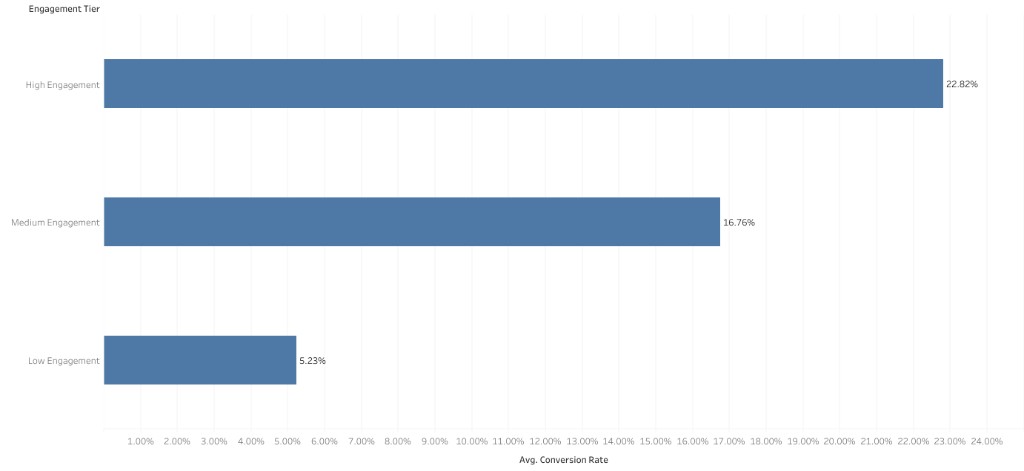
Leads segmented by engagement tier show a clear conversion gradient: high-engagement leads convert at 22.82%, medium at 16.76%, and low at 5.23%.
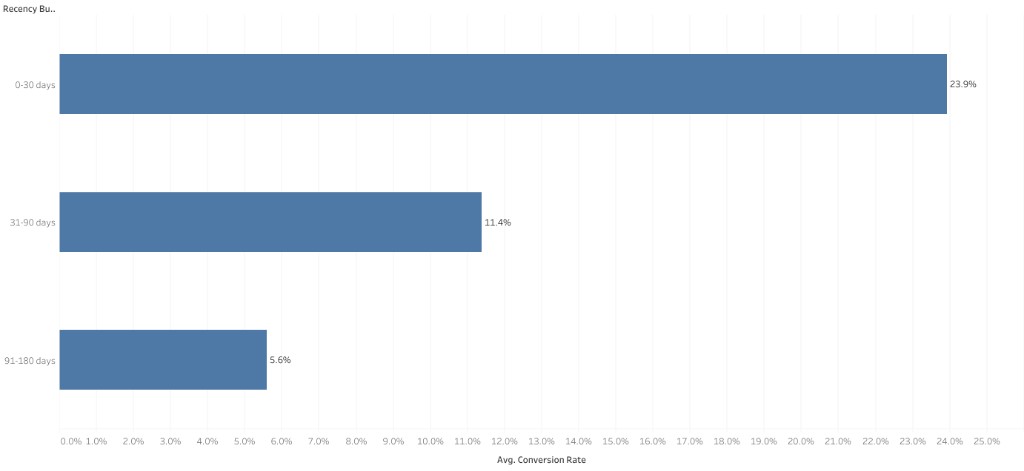
Leads segmented by recency show a clear correlation with conversion: newly acquired leads (0–30 days) convert at 23.9%, versus 11.4% for 31–90 days and 5.6% for 91–180 days.
Key findings
- Highly engaged leads converted at materially higher rates than low-engagement leads
- Recent engagement showed clear decay effects as time since activity increased
- A small subset of engaged leads drove a disproportionate share of conversions
Operational implications
- Engagement tiers support clear lead prioritization and SLA design
- Recency-based logic aligns follow-up urgency with buyer momentum
- Behavioral signals should drive lifecycle progression, not static attributes
Outcome
This project demonstrates how engagement-driven analysis can inform scalable lead management systems. Rather than correcting a broken funnel, the work focuses on systematizing what already performs well and enabling efficient growth as volume increases.